Feast Among the Stones: Where Faith Meets Flavor in Lalibela
Lalibela, Ethiopia, is more than a pilgrimage site carved from rock—it’s a sensory journey. While most come for the churches, I stayed for something unexpected: the food. Hidden in alleyways and courtyards, specialty dining here blends tradition, spirituality, and flavor like nowhere else. Think injera served on hand-carved boards, honey wine blessed in rituals, and meals shared under starlit skies. This isn’t just eating—it’s participating in a living culture. In a land where faith is etched into stone and rhythm into daily life, nourishment goes beyond the physical. It becomes an act of reverence, a thread connecting generations, a quiet miracle unfolding on woven mats and clay plates.
First Impressions: Stepping into a Sacred Landscape
From the moment you step onto the red-dusted paths of Lalibela, you feel it—a stillness that hums beneath the surface. The town does not shout; it whispers. Carved entirely from volcanic rock, the eleven medieval churches rise like secrets pulled from the earth, their spires buried and their sanctuaries revealed only when you descend into them. There are no neon signs, no loudspeakers, no souvenir stalls crowding the sacred. Instead, the air carries the scent of damp stone, frankincense, and something deeper: the warmth of woodsmoke from distant hearths.
Most visitors come to witness the architectural marvels—monolithic churches connected by tunnels and trenches, some dating back to the 12th century under King Gebre Mesqel Lalibela. But beyond the grandeur of Bete Giyorgis, shaped like a perfect cross, or the subterranean corridors of Bete Maryam, another kind of wonder unfolds quietly in the courtyards and homes nearby. It is here, in the rhythm of daily life, that food begins to reveal itself not as an afterthought, but as a central pillar of the experience.
As dusk settles, the silence is broken by the clatter of metal lids, the laughter of children, and the sizzle of onions hitting hot oil. Families gather around low wooden tables, their meals laid out on rounds of injera, the spongy sourdough flatbread that anchors Ethiopian cuisine. The smell of roasted barley for *bulla* porridge or spiced lentils for *misir wat* drifts through the alleys. It’s in these unscripted moments that you realize Lalibela feeds more than the soul—it nourishes the body with the same devotion it offers the spirit.
The Rhythm of Food and Faith
In Lalibela, the line between worship and sustenance is not just blurred—it is intentionally woven together. The rhythm of life follows the Ethiopian Orthodox calendar, which prescribes fasting on Wednesdays, Fridays, and during extended religious seasons like Lent and Advent. For up to 180 days a year, followers abstain from animal products, creating a culinary tradition deeply rooted in plant-based cooking. This is not a modern trend born of wellness culture, but a centuries-old practice of discipline and devotion.
As a result, the vegetarian dishes of Lalibela are anything but dull. I was invited into a family-run guesthouse where the host, a woman named Abeba, served me a spread of *shiro wat* (chickpea or lentil stew), *gomen* (collard greens sautéed with ginger and garlic), and *azifa* (a cool lentil salad with mustard and lemon). Each dish was slow-cooked, layered with berbere spice—a blend of chili, fenugreek, and cardamom—and served on a large injera that doubled as both plate and utensil.
What struck me most was not just the depth of flavor, but the intention behind it. “We cook with patience,” Abeba said, stirring a pot of lentils over a charcoal stove. “Because food is not just fuel. It is a gift from God, and we must honor it.” Her words echoed through the meal, reminding me that eating here is not a hurried act, but a ritual of gratitude. The absence of meat does not mean absence of richness; instead, it invites a deeper appreciation for the earth’s offerings and the hands that prepare them.
Hidden Eats: Where Locals Dine
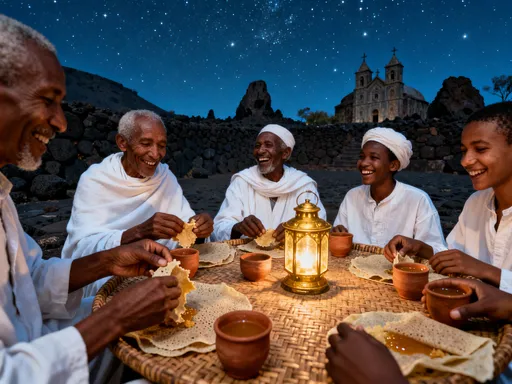
If you’re searching for a restaurant with a printed menu and laminated tables, you won’t find it in Lalibela. The best meals are not advertised—they are discovered. One evening, drawn by the scent of roasting spices and the soft glow of kerosene lanterns, I followed a narrow path behind Bete Emanuel and stumbled upon a courtyard filled with families seated on woven mats. Women in white cotton dresses—traditional *habesha kemis*—moved gracefully between tables, balancing platters of food on their heads.
There was no sign, no price list, no waiter taking orders. Instead, I was gestured to a spot beside a group of elders who nodded in greeting. Within minutes, a young girl placed a fresh injera on the mat and spooned out *doro wat*, a rich chicken stew slow-cooked with hard-boiled eggs and seasoned with berbere and *niter kibbeh* (spiced clarified butter). Beside it came *ayib*, a fresh, crumbly cheese that cut through the heat of the sauce.
I later learned this was a private home turned communal kitchen for the evening, part of a rotating tradition where families open their homes during religious festivals or family celebrations. These are not performances for tourists; they are authentic expressions of hospitality. A local guide told me, “Don’t look for signs. Look for laughter. Where you hear joy, you’ll find food.” The key to accessing these hidden tables is trust—earned through respect, humility, and the willingness to be a guest, not a customer.
Holy Ground, Heirloom Recipes
Some of the most powerful culinary traditions in Lalibela are preserved not in cookbooks, but in the hands of nuns, elders, and home cooks who carry recipes passed down for generations. At the Church of St. George, I met Sister Almaz, a nun who has lived in the convent for over thirty years. She invited me to watch as she prepared *kita*, a simple flatbread baked over open coals.
“We use no yeast,” she said, kneading the dough with practiced hands. “Just flour, water, and faith.” As she flattened the rounds and placed them on hot stones, she explained that the bread is used during fasting periods and religious services. “My grandmother made it this way. Her mother before her. We do not change it, because it is not ours to change.” The bread, when served warm, was crisp at the edges and tender within—humble in ingredients, sacred in meaning.
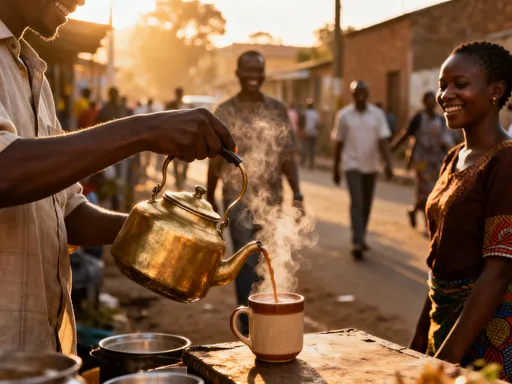
During the Timkat festival, which celebrates Epiphany with processions, hymns, and blessings of water, I witnessed another heirloom tradition: the communal cooking of *dulet*, a spiced dish made from tripe, liver, and minced meat, seasoned with chili, garlic, and herbs. Huge clay pots bubbled over open fires as neighbors stirred in unison, their movements synchronized by years of shared practice. Even the coffee ceremony, performed in nearly every home, is a ritual passed down through generations. The roasting of beans over fire, the incense burning in the corner, the three rounds of serving—*abol*, *tona*, and *baraka*—each with its own spiritual significance.
These are not recipes in the modern sense. They are living traditions, where the act of cooking is inseparable from faith, memory, and identity. To taste them is to participate in history.
Practical Magic: How to Find These Experiences
There is no app, no website, no guidebook that can guarantee you a seat at one of these hidden tables. The beauty of Lalibela’s culinary culture lies in its resistance to commodification. These meals are not designed for mass consumption—they emerge from relationships, timing, and respect.
The first step is to hire a local guide. Not a tour operator from Addis Ababa, but someone born and raised in Lalibela, preferably recommended by a trusted guesthouse or church official. These guides are not just translators of language, but of culture. They know which families are hosting meals, which festivals are approaching, and how to introduce you as a respectful guest rather than an intrusive visitor.
Staying in family-run accommodations also increases your chances of being invited. Many guesthouses, like the simple but welcoming *Selam Lodge* or *Yared Guest House*, are operated by locals who value cultural exchange. They may host small dinners, offer cooking demonstrations, or connect you with neighbors who are preparing festive meals. The longer you stay, the more you become part of the rhythm of the place.
Timing is equally important. Visiting during major festivals such as Meskel (the Finding of the True Cross in September), Timkat (January), or Fasika (Easter) dramatically increases your chances of witnessing and participating in communal feasts. During these times, the town transforms—churches overflow with worshippers, music fills the air, and food becomes a central expression of joy and gratitude.
When you do find yourself at one of these tables, remember the unspoken rules: dress modestly, especially when near churches; ask permission before taking photographs; and never rush. A meal may last two or three hours, with rounds of food, conversation, and tea. This is not inefficiency—it is intention. In Lalibela, time is not measured in minutes, but in moments of connection.
Beyond the Plate: Dining as Cultural Immersion
Eating in Lalibela is not a solitary act, nor is it merely about taste. It is a full-body experience of cultural immersion. You sit on the ground, cross-legged, on a woven *shidjo* mat. You eat with your right hand, tearing pieces of injera to scoop up stews and salads. There are no forks, no knives, no plates to separate you from the food or the people beside you.
One evening, during a post-festival gathering, I found myself seated beside an elderly woman who watched me fumble with the injera. Without a word, she gently guided my fingers, showing me how to fold the bread just right to hold the stew without tearing. Then she handed me a small cup of *tej*, the golden honey wine fermented for weeks in clay jugs. “Now you are part of us,” she said with a smile. In that moment, I understood: this was not tourism. This was belonging.
Dining in Lalibela breaks down the barriers between visitor and local, observer and participant. It invites you into a world where food is not a commodity, but a language—one spoken through shared silence, handed bread, and offered cups. It is in these quiet exchanges that the true specialty of Lalibela is revealed: not in the ingredients, but in the act of sharing itself.
Final Thoughts: A Feast That Feeds the Whole Self
The rock-hewn churches of Lalibela are rightly celebrated as wonders of human devotion and engineering. But if the churches are the crown of this sacred town, then its kitchens are its heart. Here, faith is not only prayed—it is cooked, shared, and tasted. In a world increasingly dominated by fast food, digital distractions, and curated experiences, Lalibela offers something rare: authenticity born of continuity, generosity rooted in tradition, and meals that feel like blessings.
To eat in Lalibela is to remember that food has always been more than nutrition. It is memory—of ancestors, of seasons, of survival. It is identity—of family, of faith, of place. And it is grace—offered freely, received humbly. The injera on your plate, the *tej* in your cup, the laughter across the mat—these are not services rendered, but gifts given.
So go to Lalibela for the churches, if you must. Marvel at the stone, walk the tunnels, light a candle in Bete Medhane Alem. But stay for the table. Sit with the families, learn the rhythms, accept the bread. Because in this ancient town where faith is carved into rock and flavor into every meal, you will discover that the greatest miracle is not in the architecture—but in the act of breaking bread together. Every meal here is a miracle waiting to be shared, a quiet testament to the enduring power of community, culture, and the sacredness of a shared table.